

European road freight rates edge higher in Q3 2026
Contract and spot indices reached new series highs, while road trade volumes declined and diesel costs remained elevated
The latest European Road Freight Rate Development Benchmark, published by IRU, Upply and Ti, provides an updated view of freight rate developments, road trade volumes and cost conditions across Europe.
In Q3 2026, both contract and spot rate indices increased slightly and reached new series highs.
The contract rate index reached 148.9, up 0.8 index points quarter-on-quarter and 14.6 points year-on-year.
The spot rate index reached 147.6, also up 0.8 index points quarter-on-quarter and 12.9 points year-on-year.
At the same time, road trade volumes between major EU economies declined, while diesel costs remained elevated.
The report's road trade volume comparison for May–July 2026 was 4.2% below the comparable period in 2025.
The EU weighted average diesel pump price reached €2.05/L in Q3, up 32% year-on-year.
How did markets differ across Europe?
Rate movements varied significantly by route and by market in Q3 2026.
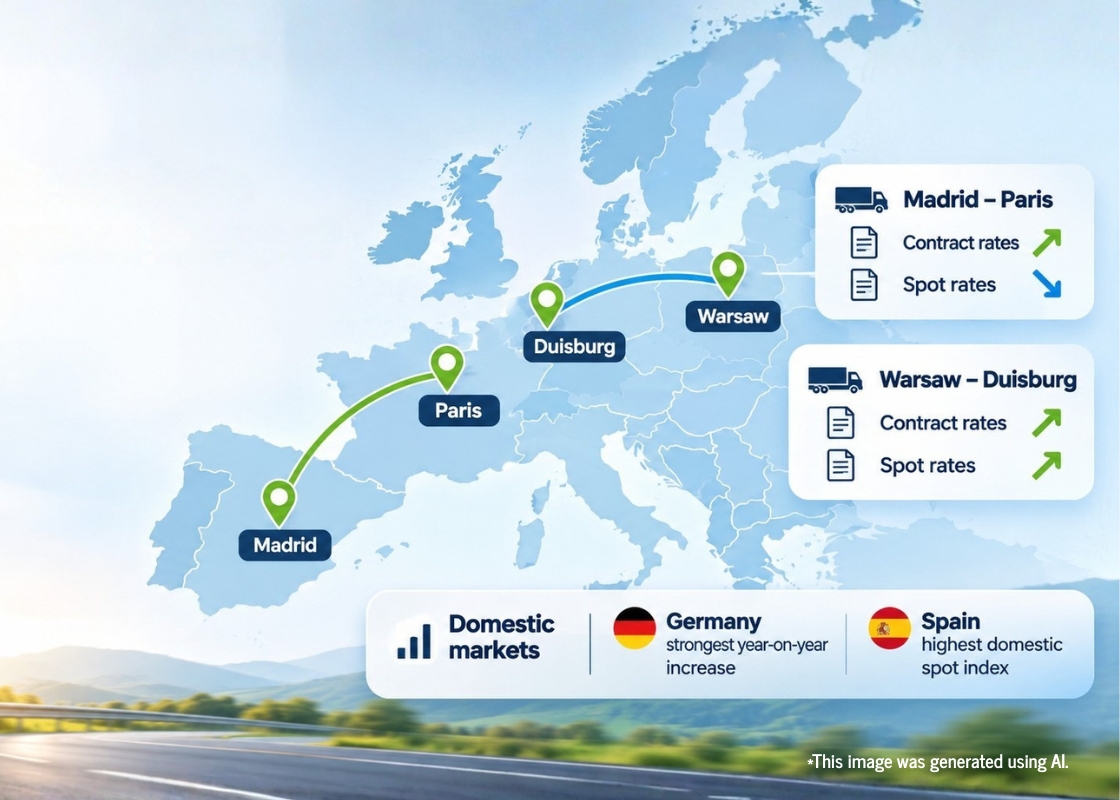
Selected international lanes showed different developments in contract and spot rates. For example, Madrid–Paris contract rates increased by 1.6 index points quarter-on-quarter, while spot rates on the same lane fell by 4.8 points.
Warsaw–Duisburg moved in the opposite direction, with both contract and spot indices increasing during the quarter.
Domestic markets also showed different patterns. Germany recorded the strongest year-on-year increase in both contract and spot rates among the four domestic markets highlighted in the report, while Spain retained the highest domestic spot index.
These examples highlight how rate developments varied across routes and domestic markets in Q3 2026.
What to watch in Q4 2026
The report highlights several signals to watch in Q4 2026.
Fuel costs remained a key supply-side pressure in Q3, and the report suggests that a sustained fall in diesel prices is unlikely in the near term.
On the demand side, peak-season activity around Singles’ Day, Black Friday and Cyber Monday could temporarily support freight volumes and spot rates. Food and consumer retail are also expected to see the usual festive lift.
Capacity conditions may remain tight, with driver shortage, fuel availability and AdBlue availability still relevant constraints.
The Road Freight Sentiment Index stood at 23.6 in Q3 2026, down 4.7 points quarter-on-quarter but still the second-highest reading on record. In the survey, 81.2% of respondents expected European road freight rates to increase over the next three months.
These should be read as market signals highlighted in the report rather than as a precise forecast for every segment of European road freight.
Download the Q3 2026 executive summaryFuel costs remained a key supply-side pressure in Q3, and the report suggests that a sustained fall in diesel prices is unlikely in the near term.
On the demand side, peak-season activity around Singles’ Day, Black Friday and Cyber Monday could temporarily support freight volumes and spot rates. Food and consumer retail are also expected to see the usual festive lift.
Capacity conditions may remain tight, with driver shortage, fuel availability and AdBlue availability still relevant constraints.
The Road Freight Sentiment Index stood at 23.6 in Q3 2026, down 4.7 points quarter-on-quarter but still the second-highest reading on record. In the survey, 81.2% of respondents expected European road freight rates to increase over the next three months.
These should be read as market signals highlighted in the report rather than as a precise forecast for every segment of European road freight.
