- International Energy Agency (IEA) – Oil Market Report (March 2026)
- Reuters – Charting the widening impact of the Iran crisis on energy markets (March 2026)
- European Commission – Energy prices and costs in Europe
- Trans.info – Iran war hits road freight on multiple fronts
- CNN Business – What the Iran war could cost
How Energy Shocks Are Affecting European Supply Chains
Understanding the impact of energy market disruptions on transport and logistics in Europe
For companies operating in international transport and logistics, these are not just geopolitical headlines — they translate directly into operational challenges: rising fuel costs, shifting capacity and increased uncertainty across supply chains.
In this article, we take a closer look at what is happening in global energy markets and what it means for transport and logistics across Europe.
A critical chokepoint: the Strait of Hormuz
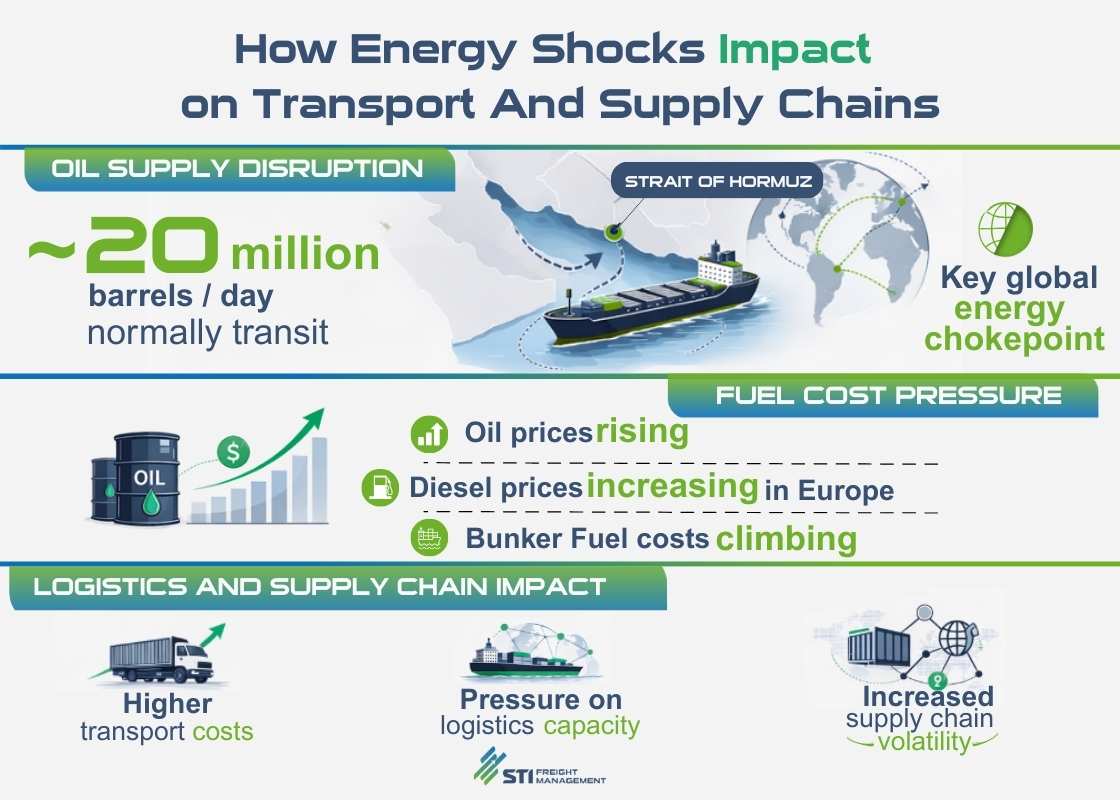
At the centre of the current disruption lies the Strait of Hormuz — one of the most important energy transit routes in the world.
According to the International Energy Agency (IEA), around 20 million barrels of oil per day, representing approximately 25% of global seaborne oil trade, normally pass through this narrow corridor.
Since the escalation of the conflict, flows through the Strait have dropped significantly. The IEA estimates that global oil supply could fall by around 8 million barrels per day, marking one of the largest supply disruptions in the history of the oil market.
Immediate market reaction: rising oil and gas prices
Energy markets have reacted rapidly.
Oil prices have increased by around $20 per barrel, briefly approaching $120 per barrel, while European natural gas prices have also surged in response to supply concerns.
Despite Europe’s relatively limited direct dependency on the Strait (around 6.2% of EU crude imports and 8.7% of LNG imports), the global nature of energy markets means that price volatility quickly spreads across regions.


Across several countries, diesel prices have risen sharply — in Germany, for example, diesel has exceeded €2 per litre. At the same time, rising bunker fuel prices and disruptions to maritime routes are adding further pressure to global logistics networks.
These developments are particularly relevant for industries that rely on stable and temperature-controlled transport, such as:
- Food and perishable goods
- Pharmaceuticals and healthcare
- Industrial and manufacturing sectors
Another key factor increasing Europe’s vulnerability is the current level of gas reserves.
This creates additional pressure on energy prices and increases the risk of continued volatility in the coming months.
The current situation is creating a complex environment for logistics operators, who are facing pressure on several fronts simultaneously:
- Rising diesel prices
- Volatile energy markets
- Potential disruptions to global shipping routes
- Increased uncertainty across supply chains
Why resilience and flexibility matter more than ever
In periods like this, resilience and flexibility across logistics networks become critical.
Supply chains across Europe depend on stable and reliable transport flows. When market conditions shift, the ability to closely monitor developments and adapt quickly becomes increasingly important.
At the same time, disruptions highlight how interconnected the logistics ecosystem really is. Shippers, carriers and logistics providers must remain in close coordination to navigate changing conditions and maintain reliable flows.
A partner you can rely on
In an environment defined by volatility and uncertainty, having a reliable logistics partner becomes essential.
At STI Freight Management, we continuously monitor market developments and work closely with our network to ensure stable, efficient and temperature-controlled transport solutions across Europe.
Our focus remains clear: supporting our customers with reliable operations, even in challenging market conditions.